Ottawa Slut Walk and “Rape Culture”

September 14th saw the 4th annual Ottawa SlutWalk, where men and women from all around came together to expose the constructs around rape culture and sexual violence. Started in 2011, the movement began as a reaction to a comment made by Toronto Police Constable Michael Sanguinetti at a York University safety forum:

“You know, I think we’re beating around the bush here,” the officer said, according to Hoffman [member of the Osgoode student government], “I’ve been told I’m not supposed to say this, however, women should avoid dressing like sluts in order not to be victimized.”

Wait…what?….did he?…

Oh yes, Jon Stewart, he did. A Toronto Police Constable went ahead and said – DESPITE the orders of what we can only assume is a superior – that women should avoid dressing like sluts if they don’t want to be raped. While the intention behind his words may not actually translate to him believing that a woman dressing in what some might consider a provocative way is a green light for rape, it sure sounds like it.

There is a lot of power in words. The old rhyme “sticks and stone may break my bones, but names will never hurt me” just doesn’t ring true anymore. While efforts can be made to let names and words thrown carelessly about roll off your back, damage is done each and every time the words are spoken. While the person speaking those words might be trying to convey the message that there are terrible people out there who will use whatever excuse they can to violate you because they have very little – if any – regard for other human beings, what ends up being heard is that the victim provoked the attack.

Victim blaming. How vile.

It’s extracted from the same vein of the “nude leaks”. As I’ve said before, these photographs were not “leaked” they were STOLEN. A thief took them from the victims and gave them to the world, making voyeurs out of a great number of the general population. Perhaps voyeur isn’t even the correct term to use here. Accomplices feels more true.

So, SlutWalk? Lets get back on topic, shall we?

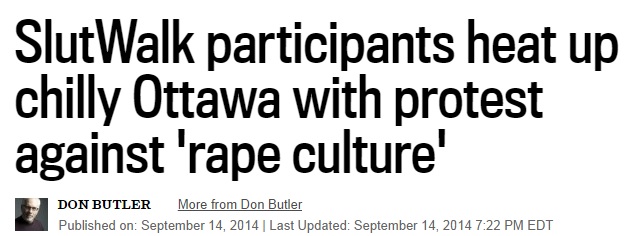
Don Butler^, a senior writer at the Ottawa Citizen, attended the Ottawa SlutWalk to report on the proceedings. After having getting a few photographs of the protesters and talking to a few participants, he proceeded to write up his article. The title?
donbutler

What’s with the scare quotes? Does he not believe that a rape culture exists? What is he skeptical of? And why the need to state “heat up”? They aren’t there to make you “hot and bothered,” or whatever euphemism you choose to substitute there. They dressed up in this manner to make people THINK.
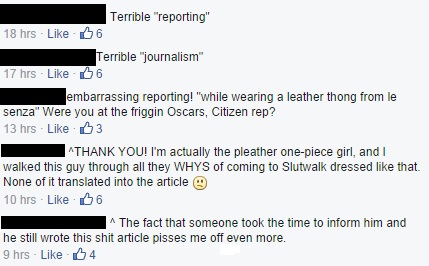
slutwalkcomments2

Once again, we have a case of someone being INFORMED as to the nature of the situation, and the message being either lost in translation, or outright ignored. The graphic above makes me all warm and fuzzy inside. The “reporting” and “journalism” in scare quotes by these two women make the reader think. By reflecting back onto the scare quotes in the title, it forces the reader to investigate. There is a basic belief that journalism should be free from bias. This is, of course, untrue. Everything is biased. Even photographic and video-graphic forms are subject to bias. Something as simple as a filter, a carefully placed light, or interpretation can change what message is being conveyed.

Take, for example, Picasso’s piece Geurnica, thought by many to be the most politically powerful piece of anti-war symbolism in the modern world. Even those who agree to this interpretation vary on the meanings within the deconstruction. The colours, the postures, the emotions…everything is subject to the viewers interpretation. Even the instructions that it should not return to Spain until democracy had been achieved? What a powerful message!

geurnica

But there are opposers. It is a creation. It is a painting that hangs in a museum. There was a time when it literally hung behind bullet-proof glass. The power and the glory of this piece can only truly be experienced by those who are fortunate enough to be able to go to Museo Reina Sofía. And then, this message is only translatable to those who are open and willing to investigate it. Call me a pessimist, but I don’t think all war-mongers, gang-bangers, and hate-filled people are cultured. Beyond that, I highly doubt that those who are cultured to some degree would think to themselves that going to see Geurnica is a logical first step to building the ethos that all future thoughts and endeavors will be based upon.

So what is it good for?

You don't get a say in this...

You don’t get a say in this…

 Pieces like Geurnica are valuable in the sense that they start conversations. Sure, most of those conversations are amongst like minded individuals, but there will be the inevitable overspill to those who might be on the fence of such a topic. It is valuable in regards to rallying for a cause. The more people talking about a single subject, the more momentum any movement that is borne from those conversations it gains.

Take, for example, the gender equality movement. Emma Watson^ was recently named goodwill Ambassador to the movement in the UN. In her speech to the UN for HeForShe, she advocated for men to join the movement as well. She eloquently outlines the reasons why this movement is a mens movement as well, calling for the end to masculine and feminine stereotypes that force strict gender binaries. Almost immediately, the recording of her speech was all over social media, being lauded as a powerful example of modern feminism.

What followed is distressing. A group of hate filled people put together a website that counted down to the release of nude photographs of Emma Watson, specifically because she made a speech on the necessity of feminism and the need for men to join in the efforts. Once the countdown expired, there were no photographs released. And the good people of the internet came to their defense! “They were never going to release pics!”, “There never were any pictures!”, and “It’s all in good fun!” were the typical responses from the typical trolls. So this was, what? A joke? How is this funny to anyone? EVEN IF Emma has never taken a nude photograph of herself and therefore had no reason to fear the publication of such photos, it still isn’t funny. What this says is “You don’t hold the power, not even over yourself. We hold the power.” and “Your voice doesn’t matter. Your privacy doesn’t matter. You are here for our pleasure”. 

So when people question the presence of “rape culture” and the need to make that conversation a priority, or make excuses for people who try to be clever and make a joke about or in the midst of the conversation, I question their integrity, their intelligence, and their morals. And when someone says “what if it were your daughter, your sister, or your mother?” I cringe. I cringe because that implies that women are still viewed, in some shape or form, as property. 

Celebrity “Scandal”? How about crime?

The internet is in an uproar. Nude photographs of numerous celebrities have found their way into the unforgiving world of digital eternity. And when I say “found their way,” what I really mean is some creep, some thief, illegally invaded the privacy of various women, took their private property, and gave it away to the world. That property just happens to be nude photographs.

mystique

No one wants to see me nude and blue. Not Charles, not the internet.

The response from the internet is, unfortunately, unsurprising. Some people are elated at the idea of getting to see Jennifer Lawrence or Kate Upton (or, the others who were targeted who I will not name, for reasons such as space in this article and a point I have yet to make on the nature of art) sans clothing. Others are responding with lividity, blaming the women for taking the vanity photographs in the first place. Their intelligence and maturity have been called into question on a massive scale. They’ve been called sluts, morons, hoes, idiots, dummies, whiners, and various other horrific names. Why? Because they had the audacity to think that their privacy is a right.

Some people have gone so far as to say that once you put something into digital form, expect it to be used against you, expect it to become the property of the public. Yet, how many of these people would be ok with their social security numbers, credit card information, and health records becoming public? I’m willing to bet that “none” is the correct answer here.

There is a common expectation amongst the general public about the privacy of celebrities. Namely, they do not get any. They get the big pay check, they get the glamour, the fame, the fabulous yacht. They get these things, and in return they surrender their privacy, become our property, in essence. Comment sections in regards to the photo theft are littered with people saying that by being a celebrity, they forfeit their rights to privacy.”It’s part of their job,” they say.

What they are really saying is this: Jennifer Lawrence lives a fantasy lifestyle, one we the public afford her by supporting her, and because we dictate her ability to live this fantasy, she in turn must become our fantasy. It’s sick, and twisted, and almost makes sense. Yes, without a fanbase Lawrence would have no career, or at least not a very lucrative one. The general public takes on the collective role of the employer. With each movie ticket purchased, with each viewing of an awards ceremony, or purchase of merchandise, the “employer” boosts the value of the celebrity. The reason that celebrity gossip rags are so popular has much to do with the idea of fantasy

The average person has limited access to the fantasy lifestyle, but they can forge a superficial connection with someone who does. It’s our way of living vicariously through another. The more we know about that celebrity, the more connected to them we feel. We want to know all about their failed relationships, their children’s crazy names, their vacations, their favourite designer, and how they live their lives. MuchMusic/MTV dedicated shows to this interest where they would take cameras on a tour of celebrity households to see exactly how they lived, and how they decorated their homes. It gives private access to someone that most people will never encounter in real life, but dedicate a decent amount of time invested in their career.

It’s a take on a business model used in the music industry:

Connect with Fans (CwF) + Reason to Buy (RtB) = The Business Model
Mike Masnick via Techdirt uses various examples to explain this model. The basic premise is that musicians make very little money off of the sale of their music. Once you take the album advance and divvy it up amongst all those who get a slice of the monetary pie, the band is left with enough to just pay the bills on their apartment and have a couple of decent dinners, if they are lucky. One adaptation of this model is seen in live concerts, where the band allows their fans to bring in recording equipment to record the live show and broadcast it for free, or transfer the audio files to FLAC and share it amongst the fan boards at no cost. Essentially, the fans are getting the live show experience for free. So, wouldn’t this hurt the musician, by not having these people attend their concerts? No. It’s smart business. The fans feel appreciated by the band, which forges a deeper connection to them, making them more likely to purchase tickets to their next live show after hearing how great they sound live from a FLAC file. This means more money for the band in the long run. The band has connected with the fans, which gives them a reason to buy. CwF+RtB= Success. Other musicians and celebrities adopt this model as well, such as Matthew Good who, during the creation of his latest album, broadcast a live stream directly from his studio in his home so that his fans could watch his creative process. We could hear him mixing sounds, humming out tunes, and testing out lyrics on tracks. It was quite fascinating. He also engages his fans in political discourse via his social media accounts, giving Good and his fans direct access to one another. Once again, smart business.
Where does this go wrong though? It falls apart when fans obtain a sense of entitlement. Despite all their efforts to be seen as a real person and not just the embodiment of a fantasy, sometimes their humanity slips away. They live lives too far away from the average person for us to be able to truly relate to them. Sometimes, the adaptation of the CwF+RtB model only furthers the fantasy of the individual, makes it fuller. When this happens, it’s easy to forget that these are real people.  They’ve connected to an image, not a person.And because this image is “our” fantasy, we get to dictate the terms. One of these terms, to a great many people, is lack of privacy. Ricky Gervais even came out and said that if they don’t want people to see them in naked pictures, that they should not TAKE naked pictures.
seriously

Hold up…wait a minute.

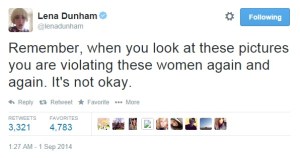
Gervais is clearly missing the point here. The point being not so much that someone stole something from these women, but that they were violated. That’s right, they were violated. Images taken of them at their most vulnerable were stolen from them and given to the general public. Their choice has been taken away from them. Everytime someone looks at these photographs, they are being violated anew.
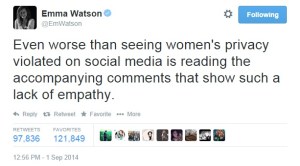
emmawatsontweet

She gets it…

lenadunhamtweet

And she gets it…

But then we see comments such as “All of these pouty lip , boobs out selfies are bad enough but gee whiz ladies, nude? Go pose for Playboy and at least get paid if you think you are that hot!!!?^” and “I actually find this funny–I mean really…computers 101…and if this culture of overly self centered stars cannot figure this out…..lol….^.” and this little gem:

Comparing careless Internet storage of nude photos to rape is very weird and does not make sense. I would compare it to stupidity. Stupid for taking them and even more stupid for storing them in your phone and on the Internet.^

Pardon? This is a prime example of missing the point entirely. The author isn’t saying that this IS rape, only comparing it to a level of sexual violation that is otherwise intangible. These women did not grant the public access to their body. These photographs are private, belonging only to the person who they are of, and those they choose to give them to. They have the right to decide who gets to see them. That choice was taken away from them when someone invaded their privacy, took their personal property, and displayed it to the world.

Scott Mendelson^ wrote an article^ showcased on the Forbes website that, I think, really gets down to the issue. What happened here is not a “leak,” it’s a crime. Not only are these women victims of theft, they are victims of digital voyeurism. It’s a crime, so we must stop calling it a “scandal”.

On a related note, the world around us is responding to this crime in interesting, and in some cases, vile ways. Spirit Airlines piggybacked the crime to promote their flight rates^, stating:

Our Bare Fare Was Leaked! We feel naked; you were never supposed to see this Bare Fare! It was meant for a special someone (who isn’t you). Now it’s all over the internet for you to take advantage of as you see fit. Scandalous! We thought the cloud was our friend, y’know, because we spend so much time flying with ’em. But now our private prices are on display! Bad for us; GREAT for you.

Notice the language? “for you to take advantage of as you see fit”. Take advantage of. I must say, this is an excellent choice of words, given that this is exactly what they are doing – taking advantage of a sexual crime against numerous women. Tasteless. I take that back, it does have a taste, and it’s disgusting. How is it ok for a corporation to not only minimize the violation of these women, but to capitalize on it? There are no amount of apologies that can make up for the perpetuation of this cult of acceptance where it relates to sexual crimes against women.

In other related news, Cory Allen Contemporary Art will be featuring artist XVALA’s series titled “No Delete” at The Showroom in St. Petersburg, Fla. in October. I’m torn about this. On the one hand, I see that there is a form of art in this, in relation to the campaign. “Fear Google” and “No Delete” means to expose the reach of the digital universe, and how when you create a digital file, it becomes it’s own life form. This subject is a behemoth, and I cannot address it all in this article, as I am already nearing my comfort level for the length of this entry. I just want to say that it really makes me uncomfortable, and I like topics that make me uncomfortable, because that means it is important.

On the other side of exposing violation through art, Emma Sulkowicz^^ of Columbia University decided that for her graduating thesis she will engaging in performance art wherein she will carry the mattress that she was raped on through campus with her. Aptly titled “Carry That Weight,” she can ask no one for assistance, but people are free to offer it to her.It is a product of her frustration and fear, and desire to expose the erroneous bureaucracy of academia and acceptance of rape culture.

Again, a subject that is formidable and which I intend to delve into in relation to CACA’s exhibit in my next article.

For now, I will be taking care to watch my language around the subject of the “photo leak”. Let’s stop calling it a leak. It wasn’t a leak, it IS a crime, a violation, and wrong on every level.

The Huntress

Job hunting is a funny thing. Not funny in a ha-ha kind of way, but more of a beat your face off of a brick wall until the pain and frustration supersedes any desire to cry over your current situation. Have you job searched in earnest in the last few years? If so, you understand.

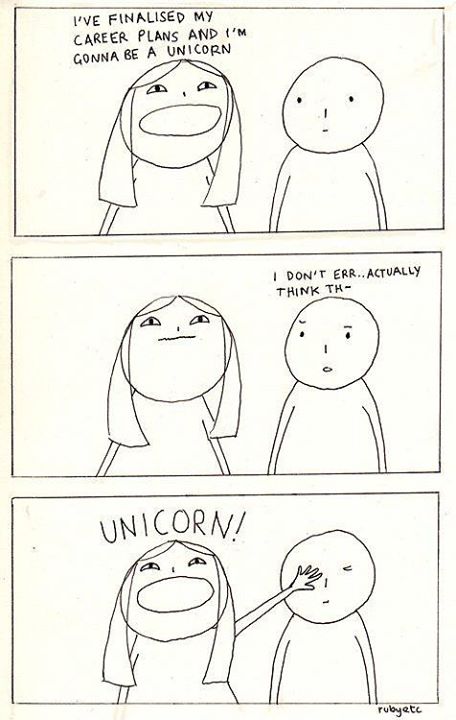
unicorn

Sometimes, I feel as though this is the only option for getting out of retail.

I came across a job advertisement a few days ago, and the moment I saw it, I knew I WANTED it. It’s an administrative internship for just shy of one year, that helps someone without the administrative title in their repertoire to gain access to a job pool that might be difficult for them to breach. As someone who has worked extensively in retail (and as a manager, you ARE the administration team) I see the potential in a position like this. And to boot, it’s in the Arts. It’s basically my dream position, to be supporting a team of creative individuals while gaining industry experience. It’s the kind of position that could change the direction of my career, something I so desperately want and need.

distress

Yeah? Whatta ’bout it?

The problem with retail is this; once you gain experience in retail, potential employers read your resume and assume that retail is all you are good for. This isn’t meant to be insulting to employers outside of retail. I see how it can be rare to read a resume like mine and think “hey, she would be a great administrative assistant!” because I’ve never held that title. Never mind that over the years, my time in retail has seen me master all of the requirements for an admin titled position, minus the odd coding program (which can always be taught to the incumbent). It’s simply the nature of the beast. Once you gain experience in a certain field, your best options are within that field.

Case? Minutes after I applied for this position, I received an email from a woman who found my resume on one of my various online profiles, and thinks I would be an excellent candidate for a management position with her company. I read the email a few times, and came to the conclusion that it was not a bot, but in fact a real person who had genuinely read my resume. I cannot tell you how tempting this potential offer is. After a few years of being outside of retail management (so that I could return to full time studies), I could definitely use the managers paycheck, as well as the added responsibilities. I’m bored out of my mind at my current job. I love my customers, but when my downtime duties do not exceed “dusting” and “facing,” it’s pretty clear it’s time to get the hell outta Dodge. Especially since I’ve told the managers I need more responsibilities, and that I dislike being idle. Every now and then they toss me a bone and I get to make a pamphlet, or a sign, but it is not enough.

Not nearly enough.

But should I go to this interview, and take on this management level position, I risk throwing myself back into the retail loop. And Lady Fortuna has been unkind to me. So I think it’s time to get off of this wheel, for all it does is turn and turn, and start a new pathway.

Shaming – Pt. 1

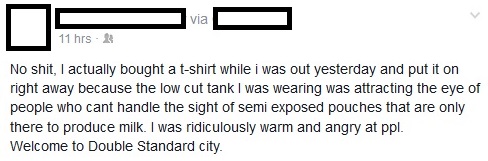
A friend of mine posted on Facebook today that she went out and spent money on a shirt because of the comments she was receiving from people on the street:

Image

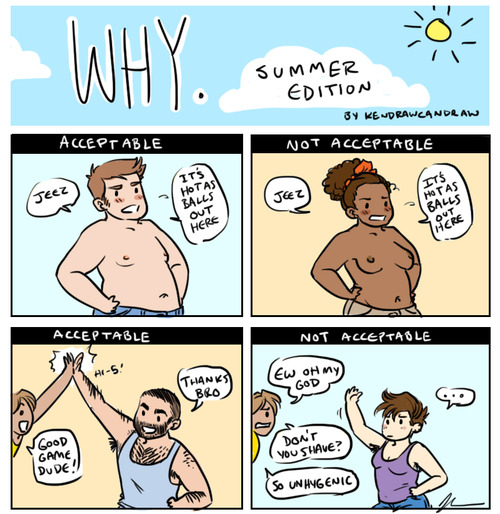
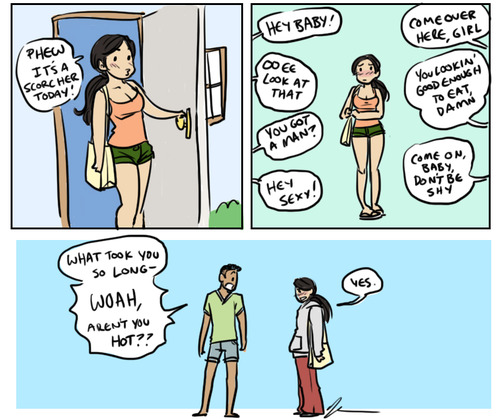
This post was followed by some panels by Kendra, which I think are both interesting and thought provoking:

Image

Image

How many girls have felt the same way that the girl in the second comic feels? I’m willing to bet most. I’m not as comfortable with my body as I could be, so I often won’t wear shorts or tank tops, opting for t-shirts and capris or bermudas, But even then, my t-shirts are sliced up to remove the neck, to open down the front a bit, or laced up at the sides to give me a little breathing room and sometimes a little flair.

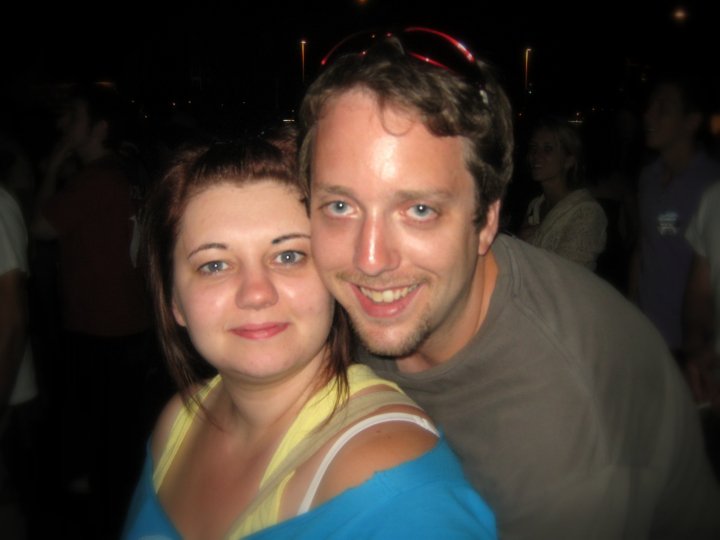
Image

Seen here: flair. And a little bit of booze?

Ever since I can remember, I’ve been well endowed. I went through puberty while still in elementary school, while most of my friends didn’t need to worry about things like bras and feminine hygiene products until middle school. Simple things like running the length of the basketball court became difficult, and boys started paying attention to me in ways they hadn’t before. At first, the attention seemed to counteract the physical discomfort, but over time I started to change my dressing habits. I stopped wearing the pretty blouses I had loved as the buttons started to pull across the chest. Instead, I would don a sweater, or a shirt that was boxier in construction. In the seventh grade, one of my friends tried to set me up with a boy who couldn’t place a face to my name. She described me to him over the phone as her “friend who wears the big sweaters so boys will look at her face instead of her boobs”.

I thought that was funny at the time. It was true, but I hadn’t really thought of it that way.

Image

For those of you who are unaware, these are eyes. You look into them while having a conversation with people.

When did I become ashamed of myself? When did that moment happen when I went from being merely slightly physically uncomfortable with the changes my body was going through to being psychologically uncomfortable with my physical self? I honestly cannot remember. I can only assume that over the years I had picked up small cues that continued to accumulate until it became so overwhelming that I was forced to react to their shadowy presence.

So I shy away from anything too low cut that looks terrible with a nice camisole underneath of it. I like to think that I don’t care what people think about me, but that is clearly untrue just based on my purchasing habits. What I wouldn’t give to be comfortable wearing a pair of actual, honest-to-goodness shorts with a tank-top and not feel like I am on display. I see girls walking down the street wearing shorts that cut up above the knee, and tank tops that require either a strapless bra or the ability to go braless with comfort and ease, and wish I could be that kind of girl. I see girls of all shapes and sizes wearing these kinds of clothes, and my reaction is always “good for her, but holy-hell am I ever jealous of her”.

Why do I feel this way? Why do I feel that I am defined by others perceptions of myself? I’ve studied Lacan. I am aware of the theory that the individual is defined not by their own perception, but by the interpretation of themselves by others. I’ve read the feminist literature, I’ve been engaged in discussion on this topic…

Yet it always seems to circle back to me again. It’s like when I think of “space”. What is out there? What is beyond what we know exists? It cannot simply go on forever, for if it does, and it is continuously expanding, what is it expanding into? What is it displacing? What exists outside of that which is being displaced? I’m sure there are answers, but my brain simply cannot process this in any logical way.

But before I even had the time to thoroughly ponder this, a response from a non-mutual friend popped up in the comments:

Image

The things about these posts that make me go twitchy are numerous, but lets expedite the process and jump right to “all men”. This statement is clearly problematic. There is an entire meme dedicated to this issue. The way to empower women is NOT to degrade men. I think very highly of most men. And I’m not going to get into gender roles, interpretations, assignments, designations, etc., I will leave those issues for another day. Trying to find an equal ground in gender perceptions is a constant battle. When statements like “all men are pigs” is put out there, men like my fiancé get lumped in there. I like to think I picked a winner. He is kind, he is generous, he has an excellent work ethic, he is political, and he is exceptionally open minded. He takes care of me when I am ill, and he doesn’t fuss when the dishes need to be done or the laundry needs to be washed (by him, as these are some of the chores we agreed that he would be in charge of). I earn significantly less than him (which is fair considering he has four degrees – a PhD included – and is working in industry, while I have only one degree and am still working in retail), yet he doesn’t consider it “his” money, but “our” money. He picked me, and I picked him. So when someone says “all men,” I get angry. How dare anyone define him in that way.

There has to be a better way of bringing women’s issues to attention than the diminishing of another gender. This does not promote equality, but encourages superiority. Superiority. You know, that thing that women have been banging their bloodied fists against for hundreds of years? Of course there are men out there who still think women aren’t as equal as themselves, that we – as a gender – are far inferior. But is the only way to draw attention to the plight of women in fact to exaggerate the quantity of men who are guilty of what only some are being rightly accused of? If we are not supposed to say things like “all women,” why does it seem to be ok with some of those women who voice against that designation to then turn around and say the same of men? Where is the line between what is acceptable in the name of change, and what is unacceptable?

I just don’t understand why we have to shame one another to begin with.