The internet is in an uproar. Nude photographs of numerous celebrities have found their way into the unforgiving world of digital eternity. And when I say “found their way,” what I really mean is some creep, some thief, illegally invaded the privacy of various women, took their private property, and gave it away to the world. That property just happens to be nude photographs.

No one wants to see me nude and blue. Not Charles, not the internet.
The response from the internet is, unfortunately, unsurprising. Some people are elated at the idea of getting to see Jennifer Lawrence or Kate Upton (or, the others who were targeted who I will not name, for reasons such as space in this article and a point I have yet to make on the nature of art) sans clothing. Others are responding with lividity, blaming the women for taking the vanity photographs in the first place. Their intelligence and maturity have been called into question on a massive scale. They’ve been called sluts, morons, hoes, idiots, dummies, whiners, and various other horrific names. Why? Because they had the audacity to think that their privacy is a right.
Some people have gone so far as to say that once you put something into digital form, expect it to be used against you, expect it to become the property of the public. Yet, how many of these people would be ok with their social security numbers, credit card information, and health records becoming public? I’m willing to bet that “none” is the correct answer here.
There is a common expectation amongst the general public about the privacy of celebrities. Namely, they do not get any. They get the big pay check, they get the glamour, the fame, the fabulous yacht. They get these things, and in return they surrender their privacy, become our property, in essence. Comment sections in regards to the photo theft are littered with people saying that by being a celebrity, they forfeit their rights to privacy.”It’s part of their job,” they say.
What they are really saying is this: Jennifer Lawrence lives a fantasy lifestyle, one we the public afford her by supporting her, and because we dictate her ability to live this fantasy, she in turn must become our fantasy. It’s sick, and twisted, and almost makes sense. Yes, without a fanbase Lawrence would have no career, or at least not a very lucrative one. The general public takes on the collective role of the employer. With each movie ticket purchased, with each viewing of an awards ceremony, or purchase of merchandise, the “employer” boosts the value of the celebrity. The reason that celebrity gossip rags are so popular has much to do with the idea of fantasy
The average person has limited access to the fantasy lifestyle, but they can forge a superficial connection with someone who does. It’s our way of living vicariously through another. The more we know about that celebrity, the more connected to them we feel. We want to know all about their failed relationships, their children’s crazy names, their vacations, their favourite designer, and how they live their lives. MuchMusic/MTV dedicated shows to this interest where they would take cameras on a tour of celebrity households to see exactly how they lived, and how they decorated their homes. It gives private access to someone that most people will never encounter in real life, but dedicate a decent amount of time invested in their career.
It’s a take on a business model used in the music industry:
Connect with Fans (CwF) + Reason to Buy (RtB) = The Business Model

Hold up…wait a minute.
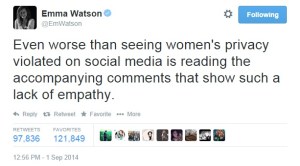
She gets it…
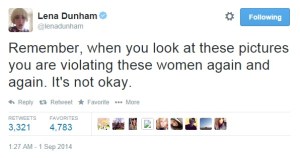
And she gets it…
But then we see comments such as “All of these pouty lip , boobs out selfies are bad enough but gee whiz ladies, nude? Go pose for Playboy and at least get paid if you think you are that hot!!!?^” and “I actually find this funny–I mean really…computers 101…and if this culture of overly self centered stars cannot figure this out…..lol….^.” and this little gem:
Comparing careless Internet storage of nude photos to rape is very weird and does not make sense. I would compare it to stupidity. Stupid for taking them and even more stupid for storing them in your phone and on the Internet.^
Pardon? This is a prime example of missing the point entirely. The author isn’t saying that this IS rape, only comparing it to a level of sexual violation that is otherwise intangible. These women did not grant the public access to their body. These photographs are private, belonging only to the person who they are of, and those they choose to give them to. They have the right to decide who gets to see them. That choice was taken away from them when someone invaded their privacy, took their personal property, and displayed it to the world.
Scott Mendelson^ wrote an article^ showcased on the Forbes website that, I think, really gets down to the issue. What happened here is not a “leak,” it’s a crime. Not only are these women victims of theft, they are victims of digital voyeurism. It’s a crime, so we must stop calling it a “scandal”.
On a related note, the world around us is responding to this crime in interesting, and in some cases, vile ways. Spirit Airlines piggybacked the crime to promote their flight rates^, stating:
Our Bare Fare Was Leaked! We feel naked; you were never supposed to see this Bare Fare! It was meant for a special someone (who isn’t you). Now it’s all over the internet for you to take advantage of as you see fit. Scandalous! We thought the cloud was our friend, y’know, because we spend so much time flying with ’em. But now our private prices are on display! Bad for us; GREAT for you.
Notice the language? “for you to take advantage of as you see fit”. Take advantage of. I must say, this is an excellent choice of words, given that this is exactly what they are doing – taking advantage of a sexual crime against numerous women. Tasteless. I take that back, it does have a taste, and it’s disgusting. How is it ok for a corporation to not only minimize the violation of these women, but to capitalize on it? There are no amount of apologies that can make up for the perpetuation of this cult of acceptance where it relates to sexual crimes against women.
In other related news, Cory Allen Contemporary Art will be featuring artist XVALA’s series titled “No Delete” at The Showroom in St. Petersburg, Fla. in October. I’m torn about this. On the one hand, I see that there is a form of art in this, in relation to the campaign. “Fear Google” and “No Delete” means to expose the reach of the digital universe, and how when you create a digital file, it becomes it’s own life form. This subject is a behemoth, and I cannot address it all in this article, as I am already nearing my comfort level for the length of this entry. I just want to say that it really makes me uncomfortable, and I like topics that make me uncomfortable, because that means it is important.
On the other side of exposing violation through art, Emma Sulkowicz^^ of Columbia University decided that for her graduating thesis she will engaging in performance art wherein she will carry the mattress that she was raped on through campus with her. Aptly titled “Carry That Weight,” she can ask no one for assistance, but people are free to offer it to her.It is a product of her frustration and fear, and desire to expose the erroneous bureaucracy of academia and acceptance of rape culture.
Again, a subject that is formidable and which I intend to delve into in relation to CACA’s exhibit in my next article.
For now, I will be taking care to watch my language around the subject of the “photo leak”. Let’s stop calling it a leak. It wasn’t a leak, it IS a crime, a violation, and wrong on every level.
 Mokahihi